Introduction
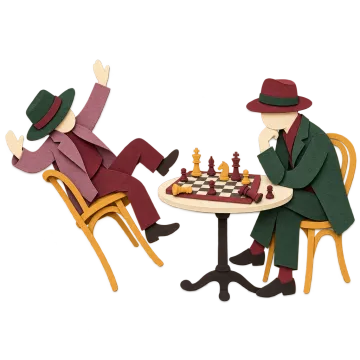
Argues the other side on principle, and is usually the reason the room found the flaw.
Somebody has just made a proposal and the room is nodding. One person is not nodding. They are leaning back with the particular expression of someone who has already spotted the hole, and what they say next will begin with okay, but what if — and it will be irritating, and it will be correct.
Twenty minutes later the proposal is better. An hour later, at lunch, the same person will argue with equal energy for a position they do not hold, purely to see whether it survives. This is not inconsistency. For a Provocateur, ideas are not possessions to be defended; they are objects to be tested, and the fastest way to test one is to hit it.
It is the mark of an educated mind to be able to entertain a thought without accepting it.
— attributed to Aristotle
What the four letters actually claim
ENTP describes someone who scores toward Extraversion (energy arrives in company and in exchange), Intuition (attention runs to possibility and connection rather than to what is in front of them), Thinking (decisions get audited for coherence rather than for harmony) and Prospecting (open questions are comfortable; premature closure is the thing that itches).
Two of those are worth being precise about, because they are routinely misread.
The Extraversion here is not sociability in the ordinary sense. A Provocateur can be uninterested in parties and still be firmly extraverted, because what recharges them is not company but contact with a mind — one good argument does more than an evening of pleasant conversation. And the Prospecting is not disorganisation, though it frequently produces it. It is a genuine preference for keeping a question open, which in the right setting is called intellectual honesty and in the wrong one is called never finishing anything.
As with every type in this framework, each letter is a continuum rather than a box, and these four map onto dimensions that academic psychology measures independently. Read what follows as a description of a direction, not a diagnosis.
The engine: contradiction as a tool
What sits underneath this type is a reflex, and the reflex is to reach for the opposite.
Presented with any claim, a Provocateur’s mind produces the counter-case automatically, before and often instead of the agreement everyone else is offering. This is not contrarianism as an identity, though it is easily mistaken for one and some Provocateurs do let it curdle into that. It is a method: the fastest way to find out whether an idea is load-bearing is to lean on it, and this type leans on everything, including their own positions, including the ones they announced ten minutes ago.
A Provocateur arguing against you is usually working, not fighting. A Provocateur agreeing with you immediately is usually not paying attention.
The method is genuinely powerful and it is why this type is so valuable in the early phase of anything. Where a group is converging too quickly, the Provocateur is the friction that makes convergence honest. Where a plan has a flaw, they will find it in the first meeting rather than the fourth month.
It also means the type’s social difficulties are not incidental. They are the same behaviour, in a setting where nobody asked for a test.
Why they are exhausting, and why it is not intended
The complaint about Provocateurs is consistent across colleagues, partners and friends: it is tiring to have everything you say examined.
From the inside, that is not what is happening. This type experiences an argument as a shared activity — something two people build together, pleasurable, without stakes, ending in a better idea and no hard feelings. They do not track that most people experience a challenged statement as a challenged person, and that a Provocateur who has cheerfully dismantled someone’s position at dinner has often, in the other person’s experience, dismantled them.
The second half of the problem is timing. This type will find the flaw in a plan someone has just committed to emotionally — a job accepted, a house bought, a relationship begun — and will say so, because the flaw is interesting and because it did not occur to them that the moment for testing has passed. Being right at the wrong time is the single most expensive habit this type has.
Why the last forty percent never happens
The other thing everyone notices, eventually.
Provocateurs generate more starts than any other type and finish a smaller proportion of them. The pattern is not laziness and it is not, usually, a failure of discipline in the ordinary sense. It is that this type is paid internally for the moment a problem becomes solvable — the insight, the connection, the moment the shape becomes visible — and once that moment has passed, the remaining work is execution, and execution is not what the machinery rewards.
So there is a shelf. Half-built projects, businesses researched exhaustively and never registered, instruments learned to the interesting plateau and abandoned, three chapters. Nearly every Provocateur over thirty has one, and nearly every one of them has a private and slightly defensive relationship with it.
The useful reframe is not finish things, which does not work. It is that this type is a genuinely excellent first sixty percent and should be paired, structurally, with someone who is a genuinely excellent last forty — and that arranging this is a skill, not an admission of failure.
What it is like from the inside
Quick, and rarely quiet.
There is a permanent low-level scanning for connections between unrelated things, and real pleasure when one lands. There is a strong resistance to being told something is simply how it is done, which begins early and does not moderate much. There is a high tolerance for uncertainty and a low tolerance for boredom, and the second causes more trouble than the first.
And there is a specific loneliness that this type does not usually name: being the person who finds the hole is a role that gets tiring to occupy, and Provocateurs are frequently more invested in being liked than their behaviour suggests. The joking, the constant testing, the refusal to take a position seriously enough to be hurt by it — some of that is temperament, and some of it is a very effective way of never being caught caring.
One thing to watch for this week: the next time you produce the counter-case automatically, notice whether anyone asked for it. Not whether you were right — whether it was wanted. Those are separate questions and this type reliably only runs the first.