


Personality Types · Observant + ProspectingFamily 04 of 04
The Movers: the ones who act
Quick, adaptable, and unusually good in the moment.
- Excellent under pressure
- Learns by doing
- Resists long horizons
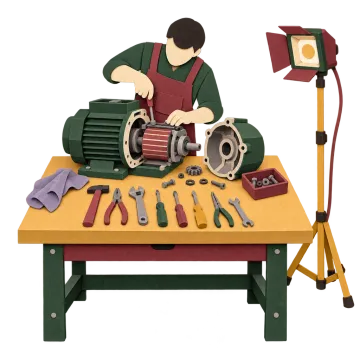
ISTP · ISFP · ESTP · ESFP
The four Movers — Tinkerer, Wanderer, Maverick and Enthusiast — are grouped together because of where their attention is.
It is here. Not on the implication, not on the plan, not on what this will mean in a year — on what is actually happening, in front of them, now. That is the whole family, and it is both the reason they are the people you want when something goes wrong and the reason so much of what goes wrong for them was visible to everybody else for years.
What the grouping actually means
These four share Sensing and Prospecting: attention on the concrete and immediate, and a comfort with situations that have not been closed down.
That combination is genuinely rare and genuinely useful. Most people are either looking past what is in front of them or need it resolved, and this family does neither — which is what allows them to keep adjusting at the point where everyone else has committed to a plan and is now defending it.
What they are collectively good at
The moment the plan meets reality. Something breaks, conditions change, the procedure does not cover it. All four are calm here and frequently solve it while other people are still establishing whose responsibility it was.
Learning by contact. None of these four take an explanation on trust. They go and find out, which makes them slower to start and much harder to fool.
Noticing what is actually there. Not what was reported, not what the model predicts — the thing itself. In diagnosis, investigation, negotiation and craft, this is the whole skill.
Being present. All four are genuinely in the room rather than planning or processing, and it is more noticeable to the people they are with than any of them realise.
The blind spot they share
Anything that cannot be perceived now is thin.
Not dismissed — unavailable. The financial position, the health thing, the relationship degrading by two percent a year, the qualification not finished, the reputation spent in small withdrawals. None of it is in the register this family watches, so it arrives as an emergency that was, to everybody else, entirely predictable.
This is worth stating carefully, because the standard advice — think about the long term, plan ahead, slow down — assumes the future is available to these types and that they are declining to look at it. It is not. Being told to consider it harder does not make it visible, which is why the advice has never worked on any of them.
What does work makes a future thing present, or converts something unfeelable into something checkable. Say the downside out loud before a consequential decision. Prepare properly for three things and compare the outcomes. Twenty minutes, in writing, once a quarter. Every one of those is a mechanism rather than an exhortation, and mechanisms are the only thing this family reliably acts on.
The second shared cost
Boredom is not a mild condition here.
For most types an unstimulating stretch is unpleasant. For these four it is a risk factor, and the outcomes associated with a high stimulation threshold and a present-tense focus are not ambiguous — in driving, in money, in substances, in decisions taken because nothing was happening.
That is not a moral observation. It is a fact about the operating characteristics of this family, and knowing it is what allows any of them to build around it, which is considerably more effective than resolving to be careful.
The thing they are unfairly accused of
Shallowness, and in the introverted two, coldness.
Both are category errors. Living in the present tense is not an absence of depth — it is depth about different things, and a Mover may have no view on the meaning of life and an extremely precise knowledge of what is actually wrong with the machine, the situation, or the person in front of them. That is not less. It is the register people actually live in.
And the flatness in the introverted two is not indifference. It is that affection is expressed as action — the thing fixed, the lift given, the turning up — which is a complete statement in their language and is consistently received as insufficient by people who were waiting for words.
How the four differ
The Tinkerer verifies by opening it. The most private of the four, the most mechanically capable, and the one whose method genuinely degrades under supervision.
The Wanderer judges by taste. Perceives immediately, cannot argue for it, and leaves rather than fights — which makes their endings look sudden and makes them the hardest of the four to hold on to.
The Maverick reads the live situation. The most socially acute, the most willing to act, and the only one of the four whose charm is also an instrument.
The Enthusiast reads the emotional weather and changes it. Does more invisible social work than the other three combined and is credited with none of it, because it is indistinguishable from having a good time.
Two are introverted and two extraverted; two are oriented to things and two to people. An ISTP and an ESFP share this page and almost nothing else.
If you are one of these
The useful thing here is not that you are quick, which you know.
It is that your costs are almost entirely deferred, and deferred costs are the specific category you cannot see. Nothing on this page suggests you should become slower or more cautious — the speed is the capability, and blunting it would cost more than it saves.
What every one of these four needs is a small number of mechanisms that make the invisible half visible: a sentence said before leaving, a downside stated out loud, three commitments that never fail, a quarter-hour a year spent on the thing that is not currently happening.
None of that requires being a different person. All of it requires accepting that there is a register you do not perceive with, and building a handrail rather than better eyesight.
The four · Observant + Prospecting
The four. Related, not identical.




Begin
Which of the four is yours?

100 statements · About ten minutes · Your type at the end