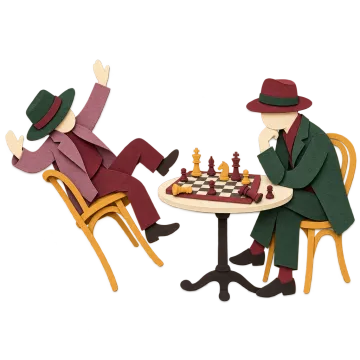
Conclusion
What to carry forward, what a type cannot be used to excuse, and where this disposition reliably pays.
A Provocateur reading eight sections about themselves has almost certainly been arguing with them, which is the correct response and also worth examining. Some of the disagreement is genuine. Some of it is the reflex, running on a document that made a claim.
The last section is about what all of this does not license.
The test of a first-rate intelligence is the ability to hold two opposed ideas in mind at the same time and still retain the ability to function.
— F. Scott Fitzgerald
A type is a starting position
The traits underneath ENTP are reasonably stable across a life. They also move, in a consistent direction, for nearly everyone: across large longitudinal studies people become somewhat more conscientious and less volatile from their twenties onward, and the size of that drift is larger than the difference between several of the sixteen types.
More practically, traits describe defaults, and defaults describe what you do when nothing is at stake. Whether you finish the thing you promised, whether you notice you hurt someone, whether the person who needs you can reach you — all of that happens in the gap between the default and the decision, and this type has as much room in that gap as anyone.
The correct use of a page like this is not “so that explains me.” It is “so that is what I will have to work around.”
The incorrect use is more available to this type than to most, because Provocateurs are good at building cases. I’m an ENTP, I just think out loud. I’m an ENTP, I get bored. These are descriptions of tendencies promoted to facts about the world, and the promotion is not something the framework earns. A person explaining what they cannot help doing is usually describing what they have chosen not to practise — and this type can construct a far more persuasive version of that sentence than most people, which makes it more dangerous rather than less.
Where this disposition reliably pays
It is worth being specific, because the returns are large and concentrated.
Anywhere a group is converging too fast. The Provocateur is the friction that makes consensus honest, and organisations without one make expensive, unanimous mistakes.
Anywhere the problem is new. Given something nobody knows how to start, this type produces a shape within days, drawing on a resemblance to something in a completely unrelated field. This is not a common ability and it does not get less valuable with age.
Anywhere the answer requires someone to be unpopular. This type will say the inconvenient thing, and will keep saying it after the room has made clear it would rather not hear it. A great deal of what improves in a company, a discipline or a family comes from someone unwilling to let the standing answer stand.
And in a genuine crisis. Rules suspended, information incomplete, improvisation required — this is the type at its best, and the people who know a Provocateur well tend to call them first when something has actually gone wrong.
Where it reliably costs
The mirror, just as plainly.
Anywhere the work is repetition. Not difficult work — repetitive work, where the answer is known and the discipline is in applying it consistently. This type degrades in those conditions and, worse, tends to interpret the degradation as evidence that the work was beneath them.
Anywhere trust is built by steadiness rather than by brilliance. Long relationships, small children, a team that needs to know what this quarter’s priorities are. Provocateurs are wonderful in the moments that require a person to be interesting and unreliable in the ones that require a person to be the same.
And in the accumulation of small unrepaired damage. The habit of leaving conflict without a mark on your own side means a Provocateur can be genuinely warm, genuinely liked, and slowly surrounded by people who are careful with them for reasons never stated.
What tends to be true of Provocateurs who thrive
A few things recur among the ones who arrive somewhere good.
They found a finisher and stopped treating the need for one as a defect. Almost without exception. The careers that look, at fifty, like a coherent body of work generally involved a second person whose name is on less of it.
They learned the timing rather than the restraint. Not fewer objections — better placed ones, raised before the decision and in private more often than in a room. The content did not change. The received value of it multiplied.
They kept one or two people who could take the full version and give it back. This type gets careful and slightly bored when everyone around them is being managed, and the antidote is not more people but a small number of unimpressed ones.
And they got honest about the deflection. The Provocateurs who are close to somebody at fifty are the ones who, at some point, answered a sincere question before making the joke, found it survivable, and did it again.
The last thing
The picture across these nine sections is of someone quick, funny, hard to pin down, structurally incapable of leaving a weak claim alone, and considerably more invested in the people around them than their behaviour advertises. If that lands, use it as a map of where the friction is — not as an account of who you have to be.
And if it does not land, that is information rather than a failure of the test. A large share of people sit near the middle of at least one of these dimensions, where the label is close to arbitrary. The description that fits you is the one that fits you, and arguing with the rest of it is, in your case, entirely in character.
One thing to watch for this week: notice the next time you explain something you did by naming your type. Then ask what the sentence would be without the type available — I can’t, or I have not bothered to learn how. You already know which one it is; the point is to hear yourself say it.